The colour series Dai Nippon Bussan Zue (Products of Greater Japan) was published by the Tokyo-based publisher Ōkura Magobei in the 19th century. The series was likely timed for the opening of the first National Industrial Exposition (Naikoku Kangyō Hakurankai) in Tokyo’s Ueno Park on 21st August 1877 and aimed at illustrating economic activities of all fifty-eight old provinces of Japan. Each province was generally represented by two scenes, and the series included images of farming, fishing, mining and other crafts involving men, women and children depicted in their traditional costume.
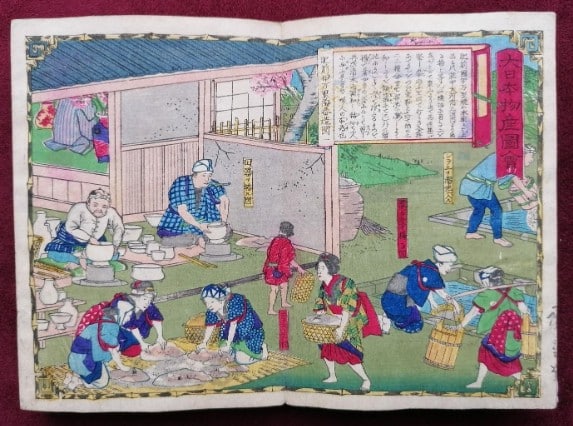
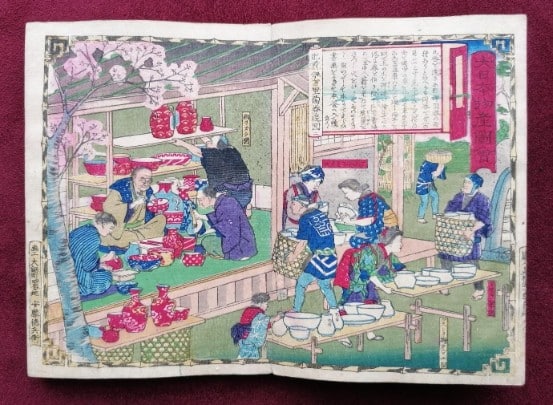
Making Imari Porcelain
Making Imari Porcelain, from Dai Nihon Bussan Zue, illustrated by Ando Tokubei (Utagawa Hiroshige III, 1842-94), Japan, [1877?] [Idd8.3.01]
Showing the production of porcelain in the old Hizen province from the rough material to the final product.
Making Imari Porcelain
Making Imari Porcelain, from Dai Nihon Bussan Zue, illustrated by Ando Tokubei (Utagawa Hiroshige III, 1842-94), Japan, [1877?] [Idd8.3.01]
Showing the production of porcelain in the old Hizen province from the rough material to the final product.
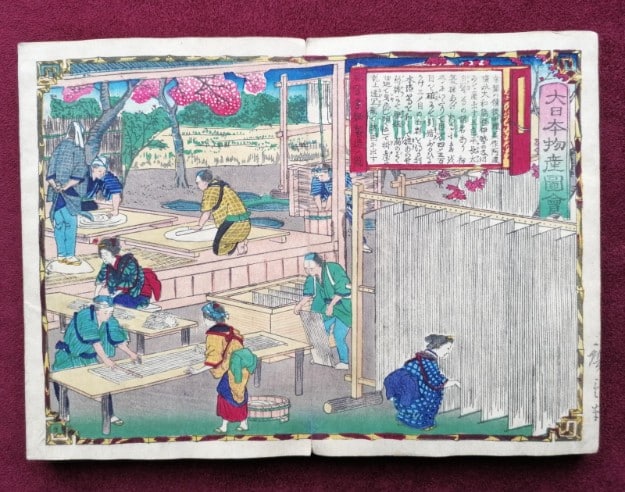
Making Somen (noodles)
Making Sōmen (noodles), from Dai Nihon Bussan Zue, illustrated by Ando Tokubei (Utagawa Hiroshige III, 1842-94), Japan, [1877?] [Idd8.3.02]
This picture illustrates the production of special noodles in the Noto Peninsula.
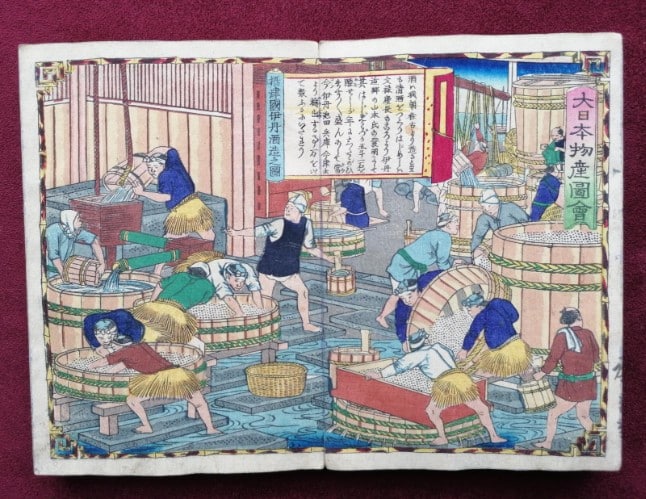
Brewing Sake
Sake Brewing, from Dai Nihon Bussan Zue, illustrated by Ando Tokubei (Utagawa Hiroshige III, 1842-94), Japan, [1877?] [Idd8.3.02]
This picture illustrates Sake brewing in the Settsu province.
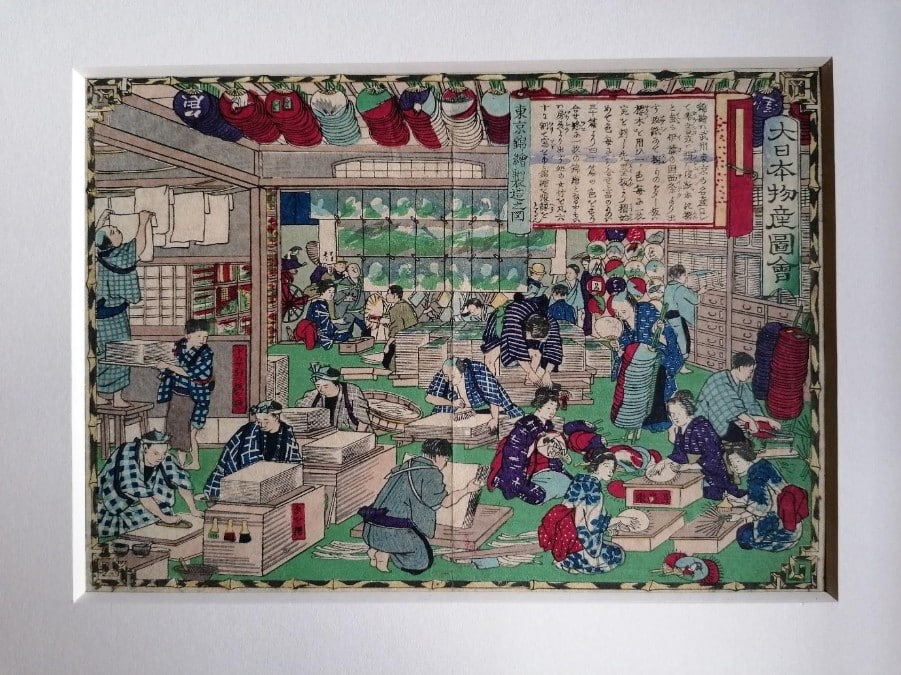
Each sheet was sold separately and there was no fixed way of ordering the prints when they were bound together. This means that extant books are unique: they do not contain the same pictures and are not in the same order. It also means that single sheets could circulate independently (not bound in books) or find a new life detached from the book, such as with the following showing a particular printing technique which combines various woodblocks (one for each colour) to produce multi-colour prints. Men and women are depicted engaged in paper-cutting, printing, bookbinding, fan-making, displaying and selling. Fans are hung from the ceiling, and at the front of the shop are landscape nishikie, portrait nishiki-e, and books strung up for display. The print was presumably removed from an album (there are remnants of glue on the verso and the fold to centre) and mounted into a white folder.
Laura Carnelos, Library Curator