


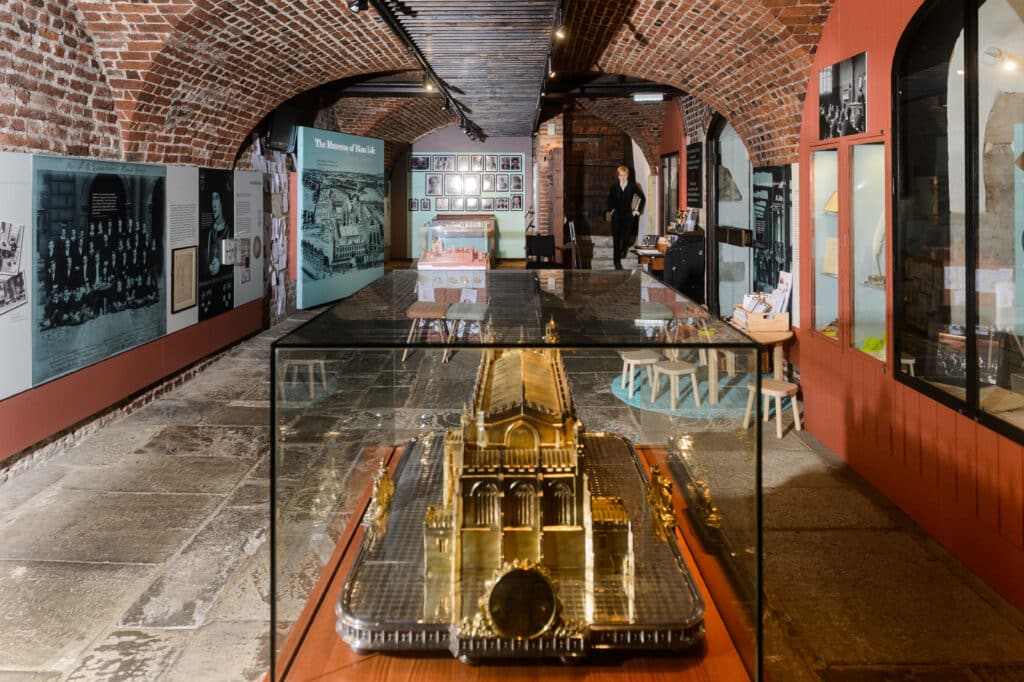
Museum of Eton Life
The natural environment around Eton, especially water, has had a large impact on Eton. The very placement of the town of Eton and the school is due to the River Thames. Throughout humanity’s history, we have required access to water for drinking and washing. It was also vital for growing crops and ensuring a food supply. In addition, rivers were important trade networks. The River Thames on which Eton sits connects all the places along it and via the sea to areas no longer connected to this country by land. Rivers also acted as natural boundaries and today separates Eton from Windsor. For all these reasons, people settled and started to live in the area that has become the town of Eton that we know. Today, the river is still an important part of Eton College, and forms the centre of a number of activities and events.
However, Eton is not immune from the changing weather patterns. Indeed, severe flooding has led to school closures and disruptions to both Eton life and the young people’s education. Whether it be flooding sports fields so they cannot be used, or flooding the sewers so it is not safe for the school to open, the impact can be felt of the effects on water levels partly due to climate change, as the Thames bursts its banks after higher levels of rainfall than we have previously faced. The more extreme weather also has an impact on certain activities people undertake.
Facing these challenges, and looking at the effects of climate change, especially that of changes in water patterns on the wider world, both the staff and boys at Eton are finding ways to adapt to the changing world and make it a better place to live. The staff are undertaking research partnerships, and various societies, such as the environmental society provide opportunities. Events such as Eton litter picks, contribute towards improving the environment. Some former pupils of Eton come up with innovative ideas and ways to bring people closer to nature.
The River Thames
The River Thames has been central to Eton’s history. Its name comes from the Old English “Ēa-tūn,” meaning “River-Town.” Settlements have long grown along the river, which provided water, transport, and trade routes. Eton itself owes its location to the Thames, which remains the focus of many events, including the Fourth of June boat procession. Over the years, the river has changed, with recent extreme weather causing significant flooding. In 2014, roads around Eton became rivers, and flooding has become more frequent in recent years. In January 2025, pupils had to begin the term from home due to flood-related delays. Flooding not only disrupts daily life and events but also damages local environments.
Efforts to reduce flooding are now underway, often bringing wider benefits for biodiversity and climate resilience. The Roundmoor Ditch Improvement Project, for example, restores riverbanks using natural features and plantings, while also providing learning opportunities for volunteers. Similarly, the local Flood Alleviation Scheme uses carefully planted meadows to slow floodwaters and enhance biodiversity.
These projects show how innovative thinking can solve multiple problems at once, helping both people and wildlife. Can you think of ways you could help projects like these? It could be volunteering, taking part in local schemes, or simply appreciating the work being done to protect the river and its environment.
Teaching and teachers’ research
Eton College is first and foremost a school, founded by Henry VI to educate scholars. His intention was that it would teach the King’s scholars and “any others whencesoever and from whatever parts they should flock… free of charge and without any pecuniary exaction”. He envisioned a religious college, providing poor scholars with a path to King’s College, Cambridge. Today, education remains central to Eton’s mission: “to draw out the best of young people’s talents and to enable them to flourish and make a positive impact on others through a healthy, happy and fulfilling life.” Environmental awareness and climate change are integral elements of this education.
Eton masters contribute to sustainability education through various projects. David Anderson, Curator of the Eton College Natural History Museum and Geography teacher, collaborates with Shane McGuinness (University College Dublin) on teaching resources about wetlands for the Royal Geographical Society with IBG. McGuinness coordinates WaterLANDS, an EU-funded, multi-million euro project with 32 partners across Europe, restoring wetlands that are featured in these resources. Wetlands are crucial for planetary health: they store carbon, filter pollutants, manage water flow, moderate flooding and coastal storms, support wildlife, and provide recreational and economic benefits. Restoring wetlands helps biodiversity while supporting local communities.
In December 2025, Pauline Herbommez, Director of Environmental Education, joined the Ice Station Expedition: 2041 Expeditions, in Antarctica. The expedition focused on preserving the Antarctic wilderness and addressing climate change. Its goals aligned with Eton’s priorities: raising awareness of Antarctica’s importance, building community pride, bringing real-world science and climate learning into classrooms, and encouraging active student participation. The expedition also strengthened Eton’s reputation for innovation and environmental responsibility. Watch a short video about the expedition here.
As part of the initiative, 2041 School was launched to help young people understand the importance of protecting one of the last great wildernesses on Earth.
Old Etonians
Old Etonians have pursued careers in many fields connected to the natural world and the environment. Tristan Gooley, known as “The Natural Navigator,” uses natural navigation to connect with and better understand the environment. He has written books for adults and children, showing how learning to read the natural world can help us live more sustainably.
Eton aims to give a holistic education beyond academics. Bear Grylls (1985-1993) helped found the school’s first mountaineering club. As a survival expert and the youngest Chief Scout in 2009, he has spent extensive time in the natural world, observing the impacts of climate change. His latest series explores how animals survive in harsh environments facing rapid environmental changes.
Rory McEwen (1932-1982), one of the finest 20th-century botanical artists, began pursuing art seriously at Eton under Wilfred Blunt. He combined scientific precision with contemporary style, documenting plant species in detail. Botanical art contributes to conservation and sustainability: by observing and recording plants, artists notice details crucial for understanding species. For example, Lucy Smith discovered a new species while drawing Giant Water Lilies at Kew Gardens. Such documentation supports research, conservation, and public appreciation of nature.
Recording and documenting species is also a long-standing practice of Old Etonians, including Sir Joseph Banks and George Thackeray. These records help us track environmental changes and identify challenges that need solutions. Can you help record species in your local area? Observations, drawings, or photographs can all contribute to understanding and protecting the natural world.
Visit the Natural History Museum to learn more about Old Etonians and their contributions to conservation, botanical art, and the study of species. Their work shows how curiosity, observation, and recording can help preserve the environment and make scientific discoveries, inspiring us to do the same in our own communities.
“Together, if we harness the very best of humankind and restore our planet we will protect it for our children, for our grandchildren and for future generations to come.”
Prince William
Co-curricular
Co-curricular activities – those undertaken outside regular lessons – are an important part of life at Eton, including environmental awareness and conservation. Many of these activities are organised by the Environmental Action Group and the Environment Society. They cover a wide range of projects, including workshops, partnerships with other schools, fundraising for environmental charities, working on Eton’s local allotment, and collaborating with the eco-club at the nearby primary school. Each year, an Environment Week showcases these efforts, and pupils are encouraged to come up with new ideas to make the school more environmentally friendly. Many initiatives, such as litter picks, can be carried out by anyone in their own communities.
Eton also has an environmental publication run by pupils, The Florentina. This allows students to explore and share topics related to sustainability, with articles ranging from the environmental impact of cryptocurrency and flight emissions to profiles of local and global environmental projects. Political actions and campaigns are also discussed, and a wildlife photography competition has been held for the Eton community. These activities encourage students to think critically about environmental issues and to engage with the natural world around them.
When you have finished in this museum, continue exploring humanity’s interaction with the natural world and water patterns throughout history, and ways we have found to positively impact it by visiting the Museum of Antiquities and Museum of Natural History to continue with this exhibition trail.