


Natural History Museum
Humanity has had many effects on the natural world, both negative and positive. Throughout history we have shaped landscapes, in many places this has led to changing weather patterns and the loss of species from all kingdoms (plants, animals, fungi, protoctista and bacteria). The landscapes have changed. While this has been detrimental, initiatives by both individuals and groups, big and small, are showing how we can reverse these changes and affect the natural world for the better.
One of the most catastrophic changes for the natural world is through changes in water patterns. In some places this is causing severe flooding with many species unable to survive, having their homes flooded and food sources destroyed. Other places are facing severe drought in which much of the ecosystem cannot survive. Melting ice not only means living organisms which rely on the ice for their homes are struggling but also affects the water levels in other places.
There are many small things we can do to make a difference. Follow the trail around this museum to understand the impacts and how they can be reduced. Some of the actions are innovative schemes which anyone can undertake without huge changes to their lives.
All of the items explored below are on display in the museum. See if you can find them!
Osprey egg
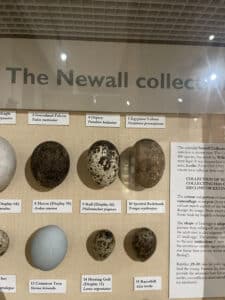
Osprey (Pandion haliartus) egg from a clutch of three eggs, cream in colour with reddish-brown speckles. NHM-NE. 15:179/A-2015; NHM-NE. 15:179/B-2015; NHM-NE. 15:179/C-2015
Ospreys (Pandion haliaetus), historically also called sea hawks, river hawks, or fish hawks, live and nest near water, feeding almost exclusively on fish. They are found worldwide and can survive in many habitats as long as there is a body of water. In the UK, ospreys were once widespread, but Victorian hunting, including for taxidermy, and egg collecting caused them to stop breeding in the country by 1916. Collecting eggs was made illegal in 1954, allowing populations to start recovering.
The pesticide DDT further threatened ospreys. DDT washed into rivers and built up in the food chain. Being top predators, ospreys ingested high levels, which caused eggshells to become thin and break before chicks could hatch. DDT affected many birds of prey in the same way. When the dangers were understood, DDT was banned in 1986, allowing populations to increase again. This shows how solutions introduced to help humans can sometimes harm nature, and how acting to remove the problem can reverse the damage.
Today, osprey populations are recovering in Scotland and beginning to return to other parts of the UK. Projects continue to restore breeding populations where they were once extinct. The Poole Harbour Osprey Project is reintroducing juvenile ospreys from Scotland to the South Coast – 180 years after the species disappeared from the area.
Ospreys show us the importance of protecting species, carefully monitoring human impacts, and acting when problems arise. Can you think of other species in your area that have been affected by human activity? What could be done to help them recover?
Further resources:
Staghorn coral

A specimen of coral, Acropora microphthalma NHM-MC.9-2015.
Between 9% and 10% of the world’s coral reefs are in the Caribbean. Many of these reefs were built by staghorn coral (Acropora cervicornis), elkhorn coral (Acropora palmata), and star corals over the last 5,000 years. Staghorn corals have branches that look like deer antlers and grow quickly, forming thickets up to five feet high and over thirty feet across. They can be pink, purple, blue, brown, or grey. These coral reefs are homes for many marine animals and protect coastal communities from flooding and erosion. Nearly half of the Caribbean’s economy depends on them. Sadly, staghorn coral is now critically endangered because of overfishing and climate change.
Coral reefs are incredibly important. Even though they cover only 1% of the Earth’s surface, a quarter of all marine life depends on them. They provide food, shelter, and breeding grounds for species like turtles, dolphins, whales, and manta rays. Coral reefs also protect habitats like mangroves and seagrass meadows, which store carbon dioxide up to fifty times more efficiently than forests. Over 1 billion people rely on reefs for their livelihoods, including fishing, tourism, and other marine industries.
The Nature Conservancy is helping restore Caribbean coral reefs. They work with local communities, governments, and schools, and have Coral Innovation Hubs in the Bahamas, US Virgin Islands, and Dominican Republic. At the Dominican Republic Hub, coral asexual reproduction and outplanting techniques are being used to grow and replant coral on reefs. By 2023, they had produced over 9.5 million coral embryos and planted 500,000 corals on reefs. Local people and students have learned how to help protect and restore coral ecosystems. Replanting corals helps marine biodiversity recover faster than if reefs collapse.
Helping to restore one ecosystem in a careful way can benefit many species and reduce the impacts of climate change. In the UK, for example, historic wood pastures with ancient oak trees are another ecosystem where careful protection benefits biodiversity.
Can you think of ways you could help protect an ecosystem in your area, whether in water, forest, or even a garden, so that plants and animals have a better chance to survive?
Further resources:
- Find out more about projects preserving and restoring coral
- Discover how Coral Innovation Hubs across the Caribbean are making a difference
Curlew
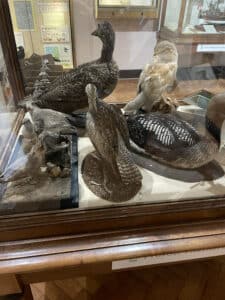
A curlew (Numenius Arquata) with typical mottled brown plumage and long curved beak, previously owned by George Thackeray. NHM-GT.40-2016.
Wading birds play an important role in ecosystems, and the largest in Europe is the curlew (Numenius arquata). Recognisable by their distinctive call, curlews spend the summer inland at breeding grounds such as wet grasslands, farmland, heath, moorlands, and bogs, then return to coasts to overwinter. Some UK-breeding birds spend winter in Ireland and France, while many curlews on British coasts come from Scandinavia.
This specimen was collected by Old Etonian George Thackery (to learn more about Eton life and community contributions to climate, visit the Museum of Eton Life). Since then, the curlew has become near-threatened due to rapid population declines. High levels of arable farming and afforestation have reduced natural habitats, including open grasslands and wetlands, which also affects carbon sequestration. Innovative conservation efforts include protecting nests and recreating lost habitats, but care must be taken to place the right habitats in the right locations. Visit the Museum of Eton Life to learn about the WaterLands project, which supports wetland restoration.
There is hope for recovery. In Oxfordshire’s Upper Thames area, the Curlew Recovery Project works with volunteers and landowners to protect nests. Electric fences are erected around nests to prevent predators from eating the eggs, and sustainable farming practices are encouraged. These efforts have successfully increased curlew populations and improved biodiversity. Learn more and watch a video here.
Banksia serrata
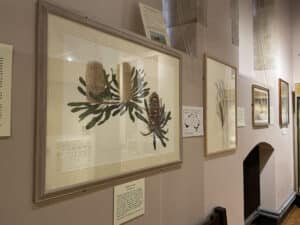
Print of Banksia serrata in watercolour by Celia Rosser, showing the flower, leaves and seeds. NHM.86-2016.
Banksia serrata is a woody shrub native to Australia, growing best in low-nutrient, well-drained soils. In coastal areas, it appears as a shrub, but usually it grows as a gnarled tree. Its cylindrical flower spikes contain hundreds of cream-grey flowers that produce nectar, an important food source for birds like the brown honeyeater and noisy friarbird, as well as for mammals. Fire tolerance is a key feature: by five to seven years old, the plant can resprout if burnt.
This illustration is one of many at the Natural History Museum, mostly from Sir Joseph Banks’ floriagium. Banks and Daniel Solander collected these plants during the Endeavour voyage with Captain James Cook, including species seen for the first time by Europeans, many from what Cook called ‘Botany Bay’. The genus Banksia was named in Banks’ honour by Carl Linnaeus Jr. Botanical illustrator Sydney Parkinson created the floriagium illustrations, which remain important records of these species. Later, 20th-century illustrator Celia Rosser also depicted the Banksia genus. Botanical art continues to combine scientific accuracy with artistry, helping research, conservation, and public understanding. This print is a reproduction of Rosser’s work.
‘Botany Bay’ is now part of the Eastern Suburbs Banksia Scrub (ESBS), home to many Banksia species, including B. serrata. In 2016, the NSW Biodiversity Conservation Act listed ESBS as critically endangered.
IndigiGrow, founded in 2018, works with the ESBS to educate young people about culture, connection to Country, and environmental care. Staffed by the Aboriginal community, the project propagates and grows local plants, combining traditional knowledge with conservation. This approach highlights the importance of working with people who live in an environment rather than imposing solutions. Inspiration from initiatives like IndigiGrow can encourage local action through volunteering or learning more about native habitats.
While the Endeavour voyage led to many botanical discoveries, it also disrupted the lives of Indigenous Australians. Today, projects such as IndigiGrow show how collaboration and respect for local knowledge can support both people and ecosystems.
Further resources:
- Learn about how Banksia Serrata is grown
- Discover Celia Rosser’s illustrations of Banksia
- Find out about other species of Banksia
Arctic tern (Sterna paradisaea)
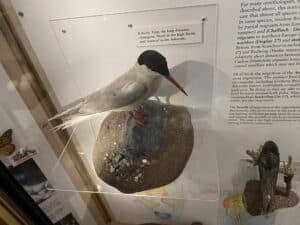
With its black head and pointed red/orange beak, this arctic tern (Sterna macrura) specimen was donated to the museum by George Thackeray. The grey and white of the body of the arctic tern helps with camouflage at sea. NHM-GT.62-2016.
The Arctic tern (Sterna paradisaea) is instantly recognisable with grey wings and back, a white underside, black head, and bright red beak and feet. Its small body, short legs, and narrow wings help it glide through the air – a vital skill for the longest migration of any animal on Earth. Each year, Arctic terns breed in the Arctic or subarctic regions and then migrate to Antarctica, following the sun and fair weather to enjoy summer at both ends of the planet. They do not fly in a straight line; one recorded tern travelled 60,000 miles (twice the Earth’s circumference)! With a lifespan of 15-30 years, Arctic terns cover enormous distances over their lives.
Fish are the main food source, supplemented by insects and crustaceans caught by plunging into water, often while gliding. Fish also play a role in courtship: males perform a “fishflight,” carrying fish and making screaming calls before offering them to females. Despite this adaptability, Arctic terns face major threats. Climate change is projected to reduce 20-50% of their habitat, with storms, rising sea temperatures, and shifting prey disrupting breeding. Human activity also poses risks. Alaska’s Arctic National Wildlife Refuge is a key rest stop during migration, but proposed large-scale oil drilling threatens the birds.
The decline of other species, like sand eels, also affects terns, showing how ecosystems are interconnected. Invasive species, such as the American mink, prey on eggs and chicks, but eradication projects in places like the Outer Hebrides have helped tern populations recover. Reporting invasive species can support these efforts.
Some solutions look to sustainable energy. Iceland, for example, has transitioned almost entirely to renewable electricity, largely from geothermal power, since the 1970s. Its Climate Action Plan sets out 150 measures to meet the Paris Agreement targets, helping protect the environment and species like the Arctic tern. This shows that using local, sustainable resources can benefit both society and wildlife.
Further information:
Carved fishing charms and Rhinoceros hornbill earring
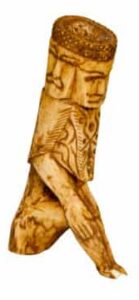
Carved bone fishing charm featuring a figure with four faces, from Miri, Sarawak, Borneo and donated by Robin Hanbury-Tenison. NHM-HT.27-2014.
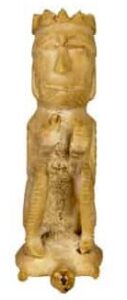
Carved bone fishing charm featuring a figure sitting on a turtle, from Miri, Sarawak, Borneo and donated by Robin Hanbury-Tenison. NHM-HT.26-2014.
These three fishing weights and the carved rhinoceros hornbill earring were collected by Robin Hanbury-Tenison in Sarawak, Malaysia, Borneo. The fishing weights were reportedly used to attract fish, with the animals depicted (turtles and snakes) found locally. The earring was made from the casque (the structure on top of the beak) of the rhinoceros hornbill (Buceros rhinoceros), the national bird of Sarawak. While hornbill products were once traded, the species is now protected. However, illegal poaching and rainforest habitat loss continue to threaten these birds, as well as other species like the helmeted hornbill (Rhinoplax vigil), which is endangered.
Rainforest loss in Borneo threatens many species, but local initiatives are helping. Illegal logging often occurs in areas of extreme poverty, where people cannot afford healthcare. Alam Sehat Lestari (ASRI), co-founded by Dr Hotlin Ompusunggu, links conservation with community support. Villagers who stop logging receive healthcare discounts, and those who cannot pay can access care in exchange for participating in reforestation and organic farming. They can even trade chainsaws or saplings grown from seed for dental care. This approach helps protect the environment while addressing poverty and health issues in Southwest Borneo, home to rare species including 10% of the world’s orangutans. Watch a video on the topic here.
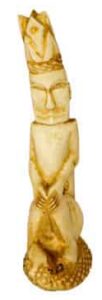
Carved fishing charm made from bone featuring a figure sitting on a snake, from Miri, Sarawak, Borneo and donated by Robin Hanbury-Tenison. NHM-HT.28-2014.
Can you think of something similar in your own community, such as asking people to bring saplings in exchange for something useful? It’s important to ensure the right species are planted in the right places to avoid unintended harm.
Projects like this can address multiple issues at once, improving people’s lives while protecting the environment. They can be adapted for other areas beyond healthcare, targeting local problems in creative ways. What small actions could you take in your community to help the environment while supporting people?
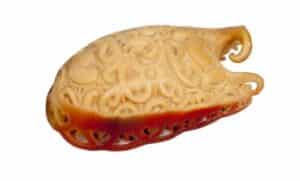
A carved earring made from the casque of a rhinoceros hornbill, from Sarawak and donated by Robin Hanbury-Tenison. NHM-HT.145-2014.
“Save the Forest, Save Lives. The health of humans and the health of the environment are inextricably intertwined. If both are not healthy, neither can be.”
Dr Kinari Webb, founder of ASRI along with Dr Hotlin Ompusunggu.
Bows and arrows
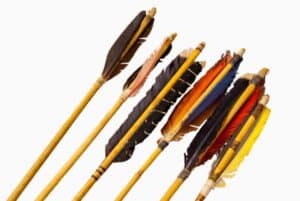
Yanomami arrows made from bamboo/cane, with matching plumes from parrots, macaws and black curassow.
These bows and arrows, made from bamboo/cane with matching plumes from parrots, macaws and black curassow, were collected by Robin Hanbury-Tenison and come from the Yanomami people in Brazil, the largest relatively isolated tribe in South America. The men spend more time preparing these arrows than any other activity and make barbs from monkey bones for birds and sharpened palm wood for monkeys.
The Yanomami people live communally in large circular houses called yanos, or shabonos, housing up to 400 people. Each family has a hearth for cooking, with hammocks slung around it at night. The centre of the house is used for feasts, games, and rituals. The Yanomami value equality and make decisions by consensus after discussion. Men hunt but never eat what they kill, instead sharing with family and friends and eating what another man kills. Women tend gardens of around 60 crops and gather other food from the forest.
The Yanomami live in one of the wettest places on Earth, the Amazon rainforest along the Venezuela-Brazil border. Water is vital to both the forest and their lives. Climate change and deforestation are affecting their environment and reducing access to clean water. Mercury from illegal gold mining has polluted rivers, and other toxic waste continues to damage ecosystems. While President Lula has declared killings of Yanomami by miners a genocide, human activity still disrupts their way of life. Shaman and activist Davi Kapenawa, through the Hutukara Foundation, works to defend the rights of the Yanomami and support environmental sustainability.
The Yanomami offer lessons in living in harmony with the environment. Almost everything they use – food, medicine, homes, tools – comes from nature. They know how to locate and harvest resources sustainably, for example moving to allow depleted areas to recover. Their botanical knowledge can also help document plant species previously unknown to science. By taking only what is needed and allowing the natural world to regenerate, the Yanomami show how humans can reduce environmental impact. Institutions like the Royal Botanic Gardens, Kew, collaborate with communities such as the Yanomami to record this knowledge.
The Yanomami live without machinery, relying on careful observation and hand tools. Can you think of things you can make just using hand tools to reduce climate change?
Further resources:
- Find out more about the Yanomami people
- Learn about how water pollution is affecting the Yanomami way of life
Pagang
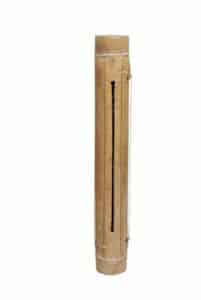
A pagang from the Penan people, made from a large piece of bamboo with raised strips creating strings. NHM-HT.9-2014
The Pagang is a bamboo string instrument played by the Penan people of Borneo. The strings are plucked to make sound, and traditionally only women play it – men are believed to be at risk from wild animals if they do. Women play the Pagang while walking through the forest, singing stories, myths, and imitating animal sounds. The instrument is made from a local bamboo species with a wide diameter, showing how the natural environment shapes culture. Similar bamboo instruments exist in China, but the local bamboo makes the Pagang unique.
The Penan are nomadic hunters and gatherers from Sarawak (Malaysia) and Brunei, living in an egalitarian society. They practise “molong” – taking only what they need – which allows them to live in harmony with nature. This principle could inspire others to reduce waste and help combat climate change.
However, climate change, deforestation, and industrial development are severely affecting the Penan. Logging, oil palm plantations, and hydroelectric dams are destroying forests, contributing to biodiversity loss and climate change, and forcing the Penan into poverty. Loss of clean water and food is harming their health. Many face threats and violence if they resist development. Bruce Parry, who visited the Penan, highlights how small changes in our actions can support people and ecosystems.
The Borneo Project brings together the knowledge of Penan and other indigenous communities with research and literature to protect the environment. The Penan’s deep understanding of their land has helped map areas and guide conservation efforts. They also cultivate nurseries to grow local trees and replant the forest.
By combining traditional knowledge with scientific approaches, positive environmental change is possible. Can you think of ways to support such projects, or work with people in your local community to bring about positive change for the climate?
Further reading:
Red Squirrel
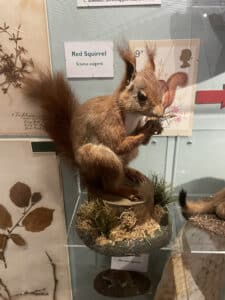
A red squirrel (Sciurus vulgaris) with distinctive tufts on its ears, previously owned by Mark Winston Smith. NHM.758-2017
The red squirrel (Sciurus vulgaris) is native to the UK and has lived here for around 10,000 years. However, in 1876, grey squirrels (Sciurus carolinensis) escaped into the wild. They often outcompete red squirrels and carry diseases, such as squirrel pox, which can kill red squirrels. Habitat management can help protect red squirrels, for example by using coniferous forests where red squirrels thrive better than grey squirrels. On the Isle of Wight, the Solent acts as a natural barrier, and it is illegal to bring grey squirrels to the island, helping the red squirrel population survive.
Citizen science is important in monitoring vulnerable species and tracking invasive species. You could help by recording what you see, contributing to projects that monitor red squirrels or minimise invasive species like the Asian hornet.
In 2025, the Red Squirrel Recovery Network received National Lottery funding for a five-year project to help red squirrels. This work includes research to find the best ways to protect the species and implementing solutions to increase their numbers. Supporting red squirrels also helps other species, as healthy ecosystems rely on many different animals in balance.
Saving Scotland’s Red Squirrels has produced a guide with suggestions to help red squirrels, many of which can be adapted to other local species.
Take a look and think about small actions you could do to protect wildlife near you.
Recording sightings, reporting invasive species, or taking small conservation actions can all make a difference.
Further reading:
- Understand the future of red squirrels through the Red Squirrel Recovery Network’s project with Heritage Fund
Monarch Butterfly
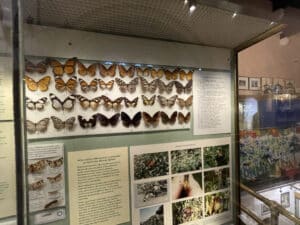
Monarch butterflies with characteristic orange and black wings, donated by David Smith. NHM-DASS.7-2017, NHM-DASS.9-2017, NHM-DASS.8-2017
The monarch butterfly migrates across the US, with some individuals travelling more than 2,800 miles from the Northeast US and Southeast Canada to central Mexico’s mountain forests. Here, under the right climate, they hibernate. Monarchs use the sun for navigation and a magnetic compass when it’s cloudy. On their return journey, it may take four to five generations to reach their starting points. Monarchs lay eggs only on milkweeds (Asclepias), which are toxic to many animals. The butterflies store these toxins to protect themselves from predators.
Climate change has caused a 59% decline in the monarch population in central Mexico during the 2023-2024 season. Factors include loss of milkweed, extreme temperatures, and shrinking overwintering habitats.
Conservation efforts in Mexico have brought hope. Working with local people, forest owners now manage habitats sustainably and have embraced tourism that coexists with the butterflies. Illegal logging has been reduced, and reforestation projects employ local communities to grow saplings and restore forests. Learning to live in harmony with nature has had a positive environmental impact. Can you think of ways you could learn to coexist with the world around you?
In Oaxaca, southern Mexico, indigenous communities are using traditional knowledge to improve climate resilience. Fog catchers, inspired by ancestral techniques from Peru, collect water molecules from nighttime fog. The mesh funnels water into reservoirs, providing 3-5 litres per square metre per night to support wildlife during droughts. These methods show how combining traditional knowledge with modern conservation can help people, wildlife, and ecosystems adapt to climate change.
Monarch butterflies and their habitats show the importance of community involvement, sustainable land management, and learning from the natural world. By observing, protecting, and working with local ecosystems, humans can help species survive and thrive in a changing climate.
Further reading:
“We have to recognise that every breath of air we take, every mouthful of food we take, comes from the natural world.”
Sir David Attenborough
Kakapo
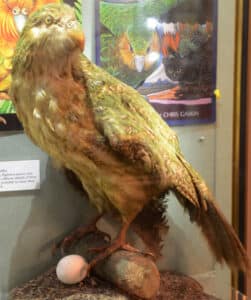
The nocturnal parrot, the kakapo (Strigops habroptilus), with it’s typical green plumage, standing on a stick with an egg. NHM.577-2017.
The kakapo is a nocturnal, greeny-yellow parrot endemic to New Zealand. It is the largest and heaviest parrot in the world and cannot fly, foraging instead on the ground and in trees. Its diet, which changes seasonally, consists entirely of plant material, including leaves, buds, flowers, ferns, bark, roots, bulbs, fruit, and seeds. Although it cannot fly, the kakapo can climb and sometimes leaps and flaps its wings, though this is not effective for flight. Low genetic diversity has contributed to low fertility in the species.
The kakapo is critically endangered, mainly due to introduced mammalian predators. New Zealand’s geographical isolation once protected birds like the kakapo, but cats, dogs, and other predators have devastated populations. Climate change has further affected food sources, such as Dacrydium cupressinum. Conservation efforts have increased numbers, but the species remains rare. What species near you have evolved due to local environmental factors? Did you know Ireland’s separation by sea means no native snakes? What invasive species introduced by humans could impact island species?
The kakapo is closely linked to the Maori people, especially the Ngāi Tahu tribe, who historically hunted the birds and used their feathers for cloaks. Recovery efforts have worked closely with the Ngāi Tahu to respect cultural traditions. The Kakapo Recovery Group, including the tribe, the Department of Conservation, and scientists, moved the remaining birds to three predator-free islands. Ngāi Tahu rangers oversee the birds, helping protect them from threats. These measures have quadrupled the population, showing how collaboration and careful protection can save species. Can you think of ways you might help species local to you? Even small actions, like surveying or suggesting ways to protect them, can make a difference.
Further reading:
Hincks Herbarium
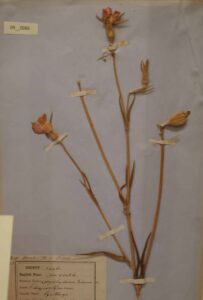
A specimen of corncockle (Agrostemma githago) from Hincks’ herbarium.
The Hincks Herbarium was rediscovered during the Natural History Museum refurbishment from 1994-2000. Named after William Hincks (1794-1891), who labelled and signed most of the pages, it preserves his collection of plant specimens. Born in Ireland, Hincks worked in Yorkshire before dying in Canada.
An herbarium is a collection of dried plant specimens, originally created to help identify species and understand their distribution. Today, herbaria are vital for studying biodiversity and environmental changes caused by humans. Scientists use specimens to study extinct or inaccessible species, and even pollen from these plants can be compared with cores from the Earth’s crust to understand past environments.
One specimen on display is the Corn Cockle (Agrostemma githago), with bright magenta flowers once common in UK cornfields. Changes in farming – herbicides, the switch to winter wheat, and intensive use of fertilizers – outcompeted the Corn Cockle, making it critically endangered. Believed extinct, it was rediscovered in 2014 near a lighthouse in Whitburn, Sunderland. Though toxic if eaten, it provides nectar for insects and can now be planted in wildlife gardens, wildflower meadows, and cottage gardens. This shows how human practices can harm biodiversity, but also how careful action can help species recover.
Herbaria have many uses beyond preserving specimens. Recording the locations of plants helps scientists find rare or nearly extinct species, such as the Ascension Island Parsley Fern (Anogramma ascensionis). Tracking geographical distribution over time supports conservation efforts, even without visiting the original locations. Discover more on the uses of herbaria here.
Research at the University of Oxford demonstrates further applications. Using Virtual Field Herbaria, people can explore biodiversity hotspots online to identify areas less critical for biodiversity. These areas could then be used for economic development, leaving the most biologically important regions protected.
Herbaria show us how studying and preserving plants helps conserve biodiversity, protect environments, and even guide sustainable development. Can you think of ways you could use observation and recording in your local environment to help nature?
Further reading:
When you have finished in this museum, please visit the Museum of Antiquities and Museum of Eton Life to learn more about humanity’s effect throughout history on the world around them, and specifically in this area, and how we can help make it a better place for every living organism.