


Museum of Antiquities
The natural world has always had a huge influence on humanity. Today, in larger towns and cities and with our increasing connectedness through technology, it can sometimes seem as though we are at odds with the natural world and its impact on our lives. However, its influence remains as profound as ever. Throughout history, people have been shaped by their surroundings, including the organisms within the environment. This influence can be seen in how people lived. From the crops they grew to the objects they created from natural materials, there are few aspects of life that have not been affected by the natural world.
Just as the natural world has shaped the world we know today and influenced every part of our lives, humanity has also had a significant impact on it. These effects have occurred throughout history, but today they have reached a point where the balance of the natural world is increasingly threatened. Climate change and global warming are terms often associated with these changes, and water is a key part of this story.
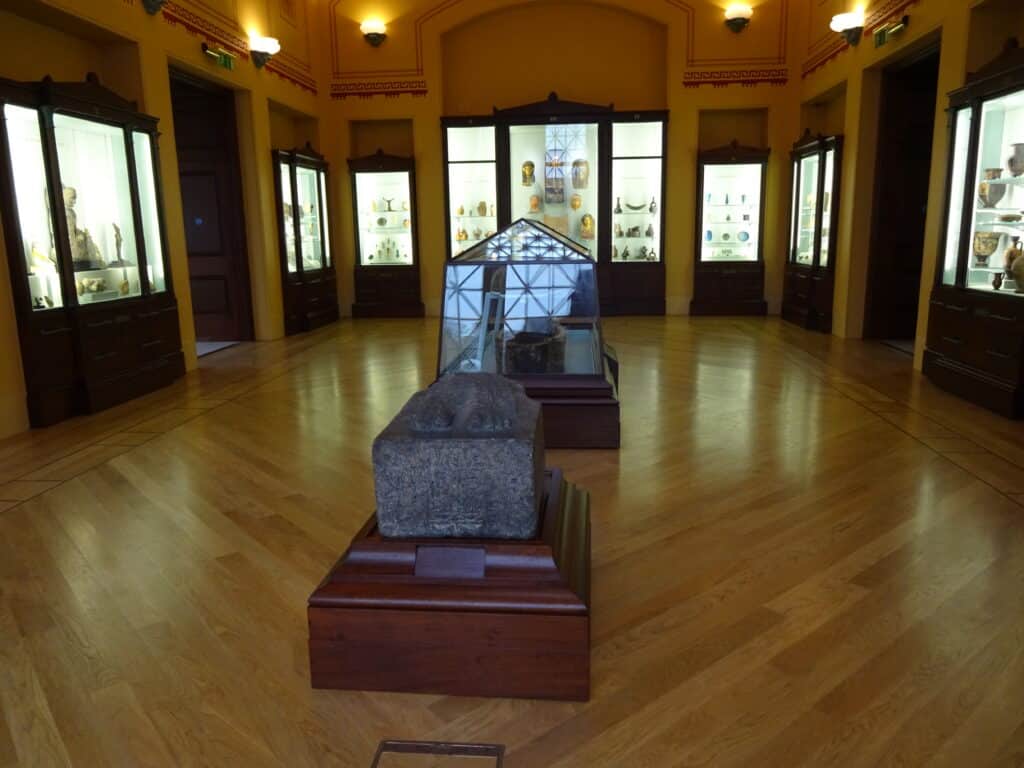
Throughout history, people have often respected the natural world and shown how it is possible to live alongside it more harmoniously. There are many ways in which we can reduce the effects of climate change and the challenges it brings. Follow this trail to learn more about how humanity has both negatively and positively affected the natural world, and how we can work together to create a more balanced and sustainable future.
All of the items explored below are on display in the museum. See if you can find them!
Stone Tools
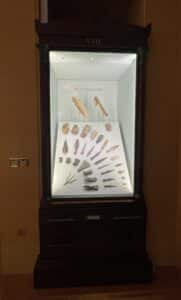
Cabinet displaying a selection of stone/flint tools including axes, arrowheads and blades, in the Museum of Antiquities.
Humans have shaped the world around them, probably more than any other species. One of the ways we’ve done this is through tools, which allowed early humans to catch animals and cut plants in ways they couldn’t before. The earliest known tools were made of flint or stone, with some dating back about 3.3 million years. The tools on display here were used for different purposes: arrowheads could be attached to wooden shafts and thrown to catch prey, while stone axes could cut timber. These examples come from all over the world, from near the Thames at Eton to Australia. Tools like these allowed humans to survive, change their environment, and evolve.
Today, tools can still affect the environment, sometimes in harmful ways. For example, mining in Myanmar is used to collect rare earth elements for things like phone and car batteries. This involves mixing water with acid to dissolve soil, which damages the land. One way we can help is by recycling old devices, buying second-hand items, or reusing objects instead of throwing them away. In fact, early humans often reused tools: sharpening edges or reshaping them into new tools. Living in harmony with the natural world often means using resources wisely, just like our ancestors did.
Tools can also help the environment. Traditional techniques like coppicing willow along riverbanks are one example. Coppicing involves cutting a tree near the ground so it can regrow. The cut wood can then be used for things like weaving baskets. This not only provides useful materials but also helps local wildlife and biodiversity. Projects like the Willow Coppice Project and the Willows and Wetlands Centre are teaching people how coppicing benefits both nature and humans.
Questions to think about:
- Can you think of objects you use every day that contain materials which come from the earth? How could you recycle or reuse them?
- What are some simple ways you could help wildlife near where you live, like planting trees or making homes for insects?
- How could old or broken items be reused to help people or the environment instead of being thrown away?
Further Resources:
Prayer Wheel
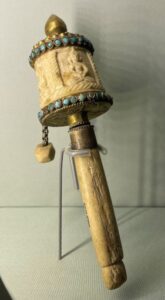
Carved bone, bronze and turquoise prayer wheel, from Tibet. ECM.5910-2017
This prayer wheel from Tibet is used in Buddhism and is believed to have the same effect as praying, helping build good karma and bringing peace to those around. The tradition can be traced back to the Bon religion, which predates Buddhism and began using prayer wheels in the fourth century AD. When Tibetan Buddhism arrived in the seventh century, it adopted some of these practices. Today, many Tibetan Buddhists carry small wheels to use multiple times a day, while others are fixed in temples. Each clockwise spin is thought to release the mantra into the world, like reciting sacred scriptures.
Tibetan Buddhists believe in respecting the balance of nature and living in harmony with the environment. However, Tibet is severely affected by climate change. This high-altitude region loses around 8 billion tonnes of ice each year. In addition, hydro-dams and mineral extraction, combined with climate impacts, threaten Tibet’s unique ecosystems.
Communities are responding with innovative solutions, such as restoring grasslands and increasing carbon sequestration, to help protect the environment and combat climate change. These efforts show how shifts in cultural beliefs and practices can contribute to environmental sustainability.
What practices can you think of which may help protect the delicate balance in the places where you live?
Statue of a Hindu goddess
Parvati, depicted here in the bronze statue, is the mother of Ganesh, also featured here. Hindus often have statues and images of their gods and goddesses in their homes. Many maintain altars (mandirs) for worship, though they also visit temples, which feature similar images.
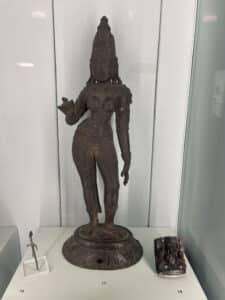
Bronze figure of Parvati from South India, dated to c. 16th century AD and clay relief of Hindu god Ganesh. ECM.5560-2017 and ECM.5905-2017.
Parvati is one of the principal goddesses in Hinduism and is generally shown as the consort of the god Shiva. In this figurine, she stands in dvibhaṅga āsana, or the “two-bend posture.” This graceful stance has two distinct bends (at the waist/torso and the hip) creating a subtle S-shaped curve that conveys elegance, rhythm, and gentle movement. Her weight rests on one leg while the other remains relaxed, and her right hand may have originally held an object, possibly a flower, as flowers are frequently symbolic attributes in Indian art.
Parvati is also known as Goddess Durga or Ādiśakti and is believed to be the reincarnation of Shiva’s first wife, Sati. She embodies power, energy, nourishment, harmony, love, beauty, devotion, and motherhood. Together with Lakshmi and Sarasvati, she forms the Tridevi, the divine trinity of goddesses. Parvati is closely associated with nature (Prakriti), reflecting Hinduism’s emphasis on living in harmony with the natural world. Rivers such as the Ganges are considered sacred, with water believed to cleanse sins. However, pollution, dam construction, and excessive water extraction – especially for agriculture – have affected the river’s flow and health.
The Mitras initiative – Friends of the Ganges (Mitras means ‘friend’ in Hindi) invites volunteers to help with tasks such as collecting rubbish, monitoring water quality, and releasing turtle hatchlings.
In Hinduism, the natural world is sacred, and people are responsible for caring for it. In some parts of India, people live alongside dangerous animals such as snakes rather than harming them. In a village in West Bengal, residents coexist with cobras (Nāgas). Even though the snakes are venomous, attacks are rare because the people do not attempt to harm or remove them. During Nāga Panchamī, it is considered auspicious to offer milk to snakes, with households placing vessels of milk outside their homes. More broadly, these practices show how living respectfully alongside nature can reduce danger, protect wildlife, and encourage mutual understanding. Such examples highlight the importance of respecting all forms of life in everyday surroundings.
Further reading:
https://divinehindu.com/goddesses/parvati-and-the-elements-wisdom-for-daily-life/
“Nature is our sustainer – we are a part of Nature. Therefore, what we do to her, we do to ourselves.”
King Charles III
Somali headrest
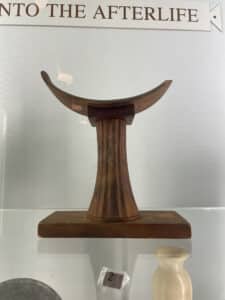
Wooden headrest from Egypt, made in three parts: rectangular base, waisted pillar with fluting and curved pillow, donated by William Joseph Myers. ECM.1796-2010. Similar headrests are found in Somalia.
Pillared headrests are found in Somalia. Their exact purpose is unknown, but they may have helped protect people from snakes and scorpions while sleeping. Typically, headrests with a rectangular base, like this one, were for females, while smaller circular or oval bases were for males. This example has a single supporting column, suggesting it belonged to a younger person, as elders used double-columned headrests. In Somali culture, on a bride’s wedding night, a sum of money called a tubash was placed under her headrest by the groom. The next morning, she would buy an amber necklace with this money as a symbol of her new status.
The shape of the headrest may also have helped prevent deep sleep, allowing people to stay alert while protecting their herds. This is one example of how the natural world influenced the design of objects and cultural practices in different environments.
Today, Somalia faces major problems from climate change. It is the second most impacted country in the world, experiencing water scarcity, flooding in some areas, and limited access to clean water. Civil conflict has worsened the situation. People are having to adapt and find innovative solutions to survive while protecting their environment.
Somalia’s Third Generation Nationally Determined Contribution highlights the importance of local solutions, working with communities, businesses, and research organisations. One example is the production of efficient cookstoves locally, which reduces energy use and emissions while supporting the local economy. Such solutions can inspire similar projects around the world.
Kayd Somali Arts and Culture, founded in 2009, preserves Somali arts and culture while supporting community-led environmental solutions and partnerships to address climate challenges. Learning from how cultures interact with their environment can inspire new ideas to combat climate change and protect the natural world.
Through objects like this headrest and the traditions around it, we can see how human culture is shaped by nature. Can you think of ways people in your local community could work together to solve environmental problems while respecting local traditions?
Further reading:
Amulet – scarab
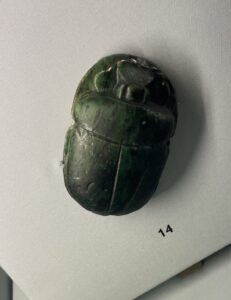
A scarab amulet made from green glazed steatite, donated by William Joseph Myers. ECM.1641-2010.
Scarab beetle amulets, like this one, were popular from the early Middle Kingdom (around 2000 BC). The scarab symbolized resurrection, inspired by its life cycle: hatching from an egg inside a ball of dung and rolling these balls across the ground. Because of this, the scarab was linked to Atum, the god of creation, and Re, the sun god. Together, Atum-Re represented the power of the sun and creation. The scarab was also associated with Khepri, the god of rebirth and transformation. Scarab amulets offered protection and were often buried with people to safeguard them in the afterlife, showing how Ancient Egyptians drew inspiration from the natural world.
Studying scarab beetles from this period helps scientists understand past climate changes. Evidence from beetles, pollen, charcoal, and texts suggests that around 2200 BC, Egypt experienced a major climate shift, possibly linked to volcanic activity. This affected the annual Nile floods, disrupted food production, and contributed to social change, including the fall of the Old Kingdom. Ancient Egyptians adapted by rethinking food systems and sometimes migrating – showing that societies can respond to environmental challenges.
Today, climate change is happening faster and is largely driven by humans. In Egypt, it continues to disrupt weather and Nile floods, impacting many aspects of life. Some modern solutions take inspiration from scarabs. The Dung Beetle Project (https://dungbeetle.africa) uses the idea of beetles recycling waste to turn single-use plastics into energy. This energy powers a stage for live music, talks, and science education, showing how nature-inspired approaches can provide energy where it’s otherwise scarce. Such innovations highlight creative ways humans can respond to environmental challenges, though potential impacts, like carbon emissions, must be considered.
Sources and further reading:
- Bárta, Miroslav & Bezdek, Ales. (2008): Beetles and the decline of the Old Kingdom: climate change in ancient Egypt.
Peruvian vessels
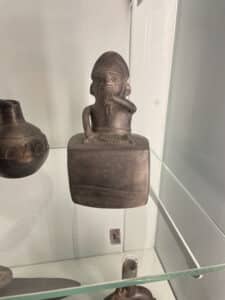
Peruvian vessel should a person playing an instrument
Pottery vessels from Peru, such as those displayed here, were made in red and black clay and often depict animals native to the region. Some, like the vessel with figures under a canopy displayed here, contain whistles. Some of these whistling vessels, found in pre-Columbian South America, were designed so water inside would move when tipped, forcing air through the whistle to make a sound. Water was essential both for the function of these objects and for life in Peru.
Peru faces climate-related challenges, including floods, droughts, and landslides. For millennia, Peruvians have developed solutions for water management and climate resilience. One example is Moyobamba, where declining water quality in the early 2000s was linked to converting rainforest into farmland. Local leaders, the water utility, and upstream communities collaborated to raise awareness about forest conservation. A publicly approved tariff now funds a seed program that restores and protects montane rainforest – improving water quality and reliability.
Along Peru’s dry coast, seasonal fog from the Pacific Ocean creates unique ecosystems called lomas. These areas support flora adapted to rare and temporary conditions. Lomas are difficult to study because they appear only under certain conditions. Twenty years of research at Kew Gardens has enabled the creation of conservation areas, such as Lomas Amara and Lomas Uilujaya, helping to protect these fragile ecosystems. Botanic gardens play a vital role in studying and conserving environments like these. Visiting and supporting such institutions contributes to ongoing conservation efforts.
These vessels and ecosystems show how humans and nature are connected: water shaped the function of the pottery and the survival of local communities and plants. Can you think of ways water is important in your area, and how you could help protect it?
Further reading:
“What you do makes a difference, and you have to decide what kind of difference you want to make.”
Dr. Jane Goodall
Ibis amulet
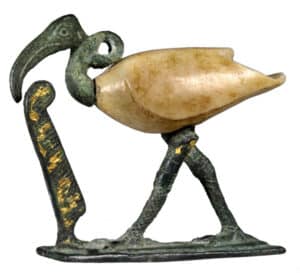
Ibis amulet with a calcite body and gilded bronze attachments, donated by William Joseph Myers. ECM.1692-2010.
Animals and plants native to an area had important meanings in Ancient Egyptian culture, shaping daily life and showing how the natural world influenced humans. The ibis was one such important symbol, believed to represent Thoth, the god of knowledge and writing. Its curved beak may have reminded people of the crescent moon, linking it to Thoth as a Moon god. Amulets like this one were worn for protection and wisdom, thought to help the wearer have a favourable passage to the afterlife.
The ibis depicted here is the African sacred ibis (Threskiornis aethiopicus), which nests near water and feeds in shallow wetlands. At the time this amulet was made, the species was native to Egypt. Today, it is extinct in Egypt, though populations remain elsewhere in Africa. Habitat changes, hunting, and the mass mummification of ibis (likely for religious purposes) may have contributed to their local decline. This shows that while humans were connected to nature, their actions could also impact populations of species.
Native species have often shaped cultures through objects made from them, depictions, and associated meanings. Protecting these species helps preserve culture and history while also supporting ecosystems and combating climate change. Can you think of animals in your culture that have special meanings? Are they endangered? What could you do to help protect them? This might be as small as planting a species that supports them, or recording sightings in areas you visit.
In Egypt, climate change is causing serious problems such as water scarcity, but innovative solutions are emerging. The Al Muranha project uses nature-based solutions with a focus on local community engagement to improve water and agricultural management. It specifically supports women, young people, and vulnerable communities to co-develop solutions that strengthen both people and ecosystems.
Further resources:
Writing and writing implements

Collected by Myers in Egypt, this wooden leaf from a codex would have been covered in wax which could have been written on. ECM.1615-2010.
Writing has been important across cultures for thousands of years. In the Ancient Near East (Cuneiform), Ancient Egypt (Hieroglyphs), and Ancient Greece and Rome (Ancient Greek and Latin), it recorded agriculture, finance, religion, history, and learning. The natural world shaped the tools used: Egyptian papyrus and beeswax tablets are examples, and many hieroglyphs depict shapes seen in nature. Different materials influenced how cultures wrote and learned.
In Ancient Rome, Greece and Egypt, wax tablets such as this one, could be reused multiple times. A stylus had a pointed end for writing and a rounded end to erase marks. The wax could be melted or replaced, making the tablets reusable – a form of recycling! Beeswax, sourced from beekeeping, was widely used. As in many ancient societies, bees and their products were vital. This continues in the Mediterranean today, though bees now face threats from environmental changes and climate impacts.
Around the Mediterranean, climate change is affecting bees in many ways. Changes in flowering times reduce nectar availability, droughts limit water sources, and harsh winters lower survival rates. Bees are crucial for pollinating crops and wild plants, allowing plants to reproduce. A decline in bee populations can have serious consequences for ecosystems and the wider environment.
The MediBees project works to support Mediterranean bee species. It monitors populations, helps beekeepers build colonies resilient to changing climates, and promotes local bee biodiversity. This boosts threatened subspecies and strengthens ecosystems. You can also help insects survive by providing accessible water, planting native wildflowers, or helping bees when they appear dehydrated.
Further reading:
Greek vessel
Pottery has been important to humans for millennia, used to create vessels for cooking, storage, and decoration. During the Ancient Greek period, black-figure pottery, like this amphora, often depicted scenes from mythology. This amphora shows Ariadne, daughter of King Minos of Crete, and Dionysus, the god of wine, orchards, fruit, fertility, and festivity, with their nine children. Vines and ivy are also depicted, showing how the natural world influenced Greek art and how the Greeks recognised the importance of agriculture, particularly grape vines for wine production.
This amphora, part of the Hamilton Collection, comes from Attica, the historical region including Athens. Grapevines remain important in Greece today but are increasingly affected by climate change. Extreme weather, including severe droughts and wildfire risk, threatens vineyards and local communities. Greece ranks 19th globally for water scarcity. In 2025, the country launched a National Water Strategy, and the EU-funded ARSINOE project explores climate adaptation solutions.
One approach in Athens draws on a 2,000-year-old Roman aqueduct built under Emperor Hadrian. Hundreds of wells collected water from rivers and streams into underground channels, supplying the city reliably until the 15th century under Ottoman rule. Modern engineers realised this ancient system could help address water scarcity today, showing how solutions from thousands of years ago can support both human survival and the environment. Care is still needed to manage water use sustainably.
The Greeks’ connection to the natural world influenced both their art and their society. Their innovations, like aqueducts, show how observing and working with nature can create long-lasting solutions. Can you think of ancient inventions that might help us today? These could be creations not currently in use but could be revived or adapted. The aqueducts worked without modern technology, yet still supported large communities.
Further information & reading:
When you have finished in this museum, please visit the Museum of Natural History and Museum of Eton Life to learn about humanity’s effect throughout history on the natural world, specifically in this area, and how we can help make it a better place for every living organism.