From Plato onwards, ancient Greek philosophers sought to explain the complex but orderly movements of the sun, moon, planets and stars as combinations of uniform circular motions. Around 330 BCE, Aristotle developed mathematical systems of a universe built up of concentric spheres into a fully worked out model of the physical universe.
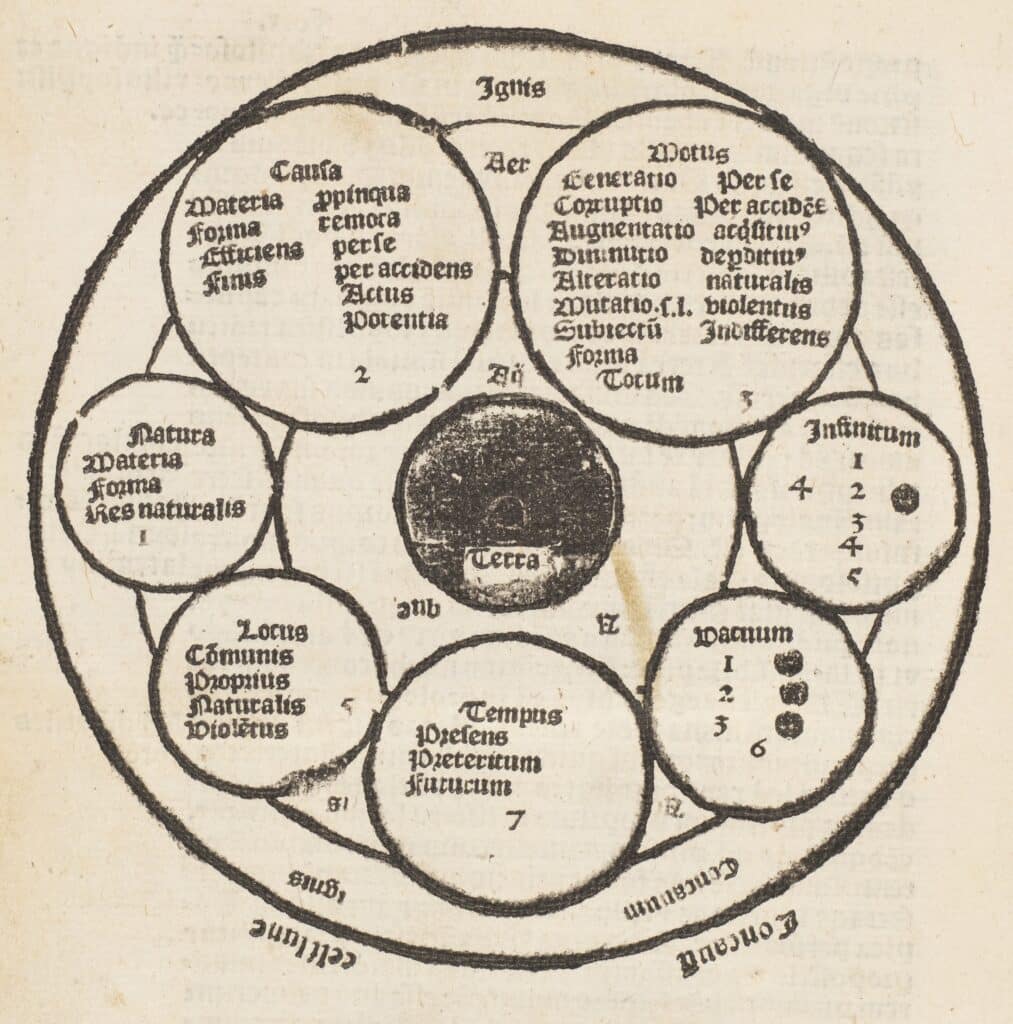
Aristotle’s Physics divided the universe into two realms. In the sublunar world (literally ‘below the moon’), the four basic elements of Earth, Water, Air and Fire are subject to constant growth, change and decomposition, whereas above the moon in the superlunar world, the five known planets and innumerable fixed stars followed their courses with perfect regularity. In Aristotle’s physics, solid earth as the heaviest element lay at the centre of a geocentric universe within concentric spheres of water, air, fire, themselves surrounded by the orbits of the celestial bodies fixed in constantly rotating spheres of a perfect unchanging fifth element called ‘aether’.
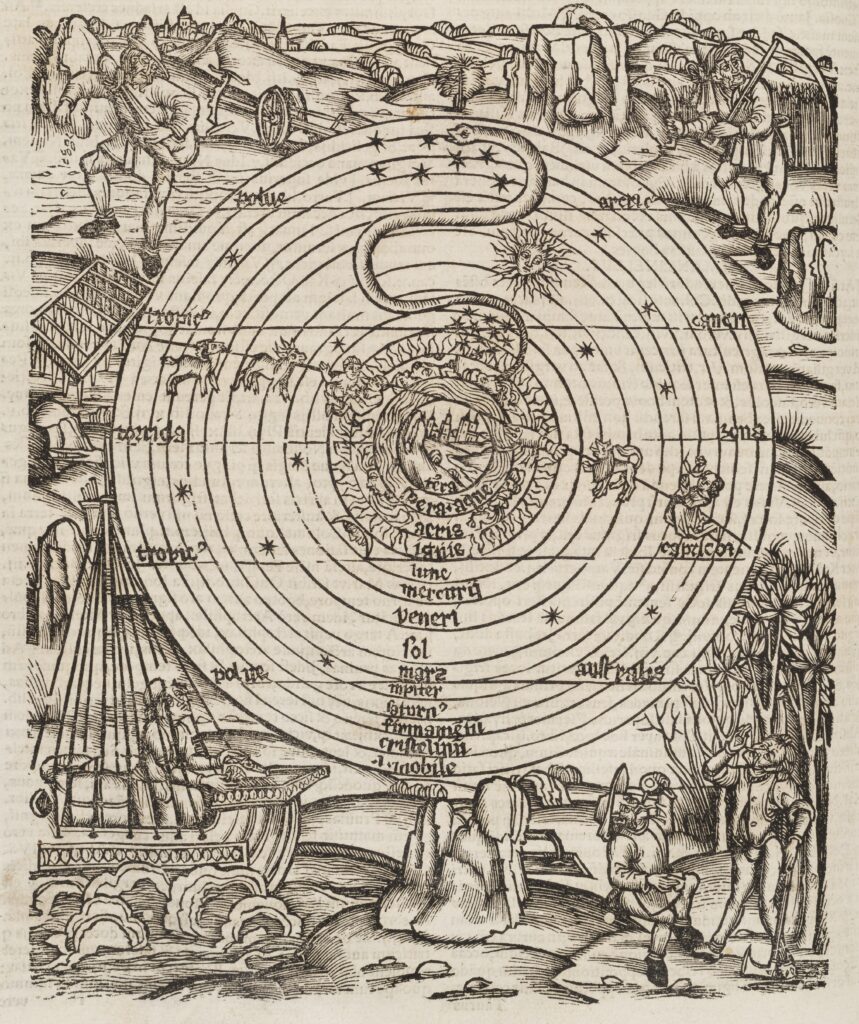
Later astronomers noted that Aristotelian physics did not explain their observations accurately. Ptolemy around 150 CE and the medieval Arab astronomers who inherited Greek learning tried address these problems, offering different models to account for these discrepancies. Medieval Christian philosophers and astronomers inherited these problems. They additionally tried to make Aristotle’s perfect spheres compatible with the biblical account of creation in which God gathered the waters together to create dry land, and the oceans were not higher than the mountains.
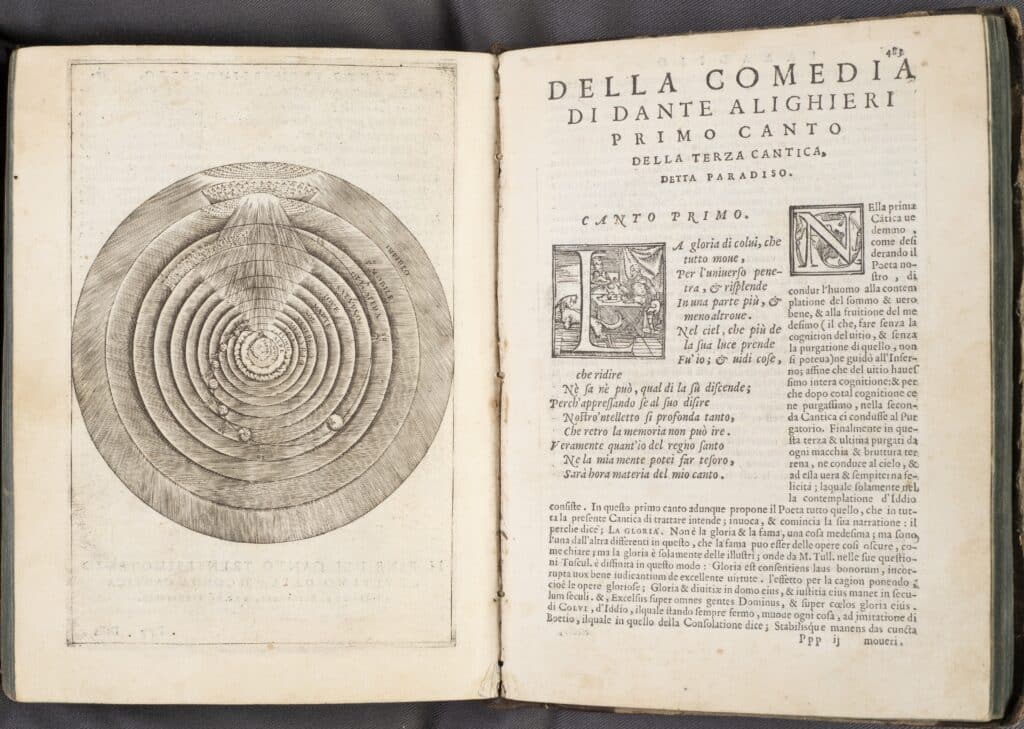
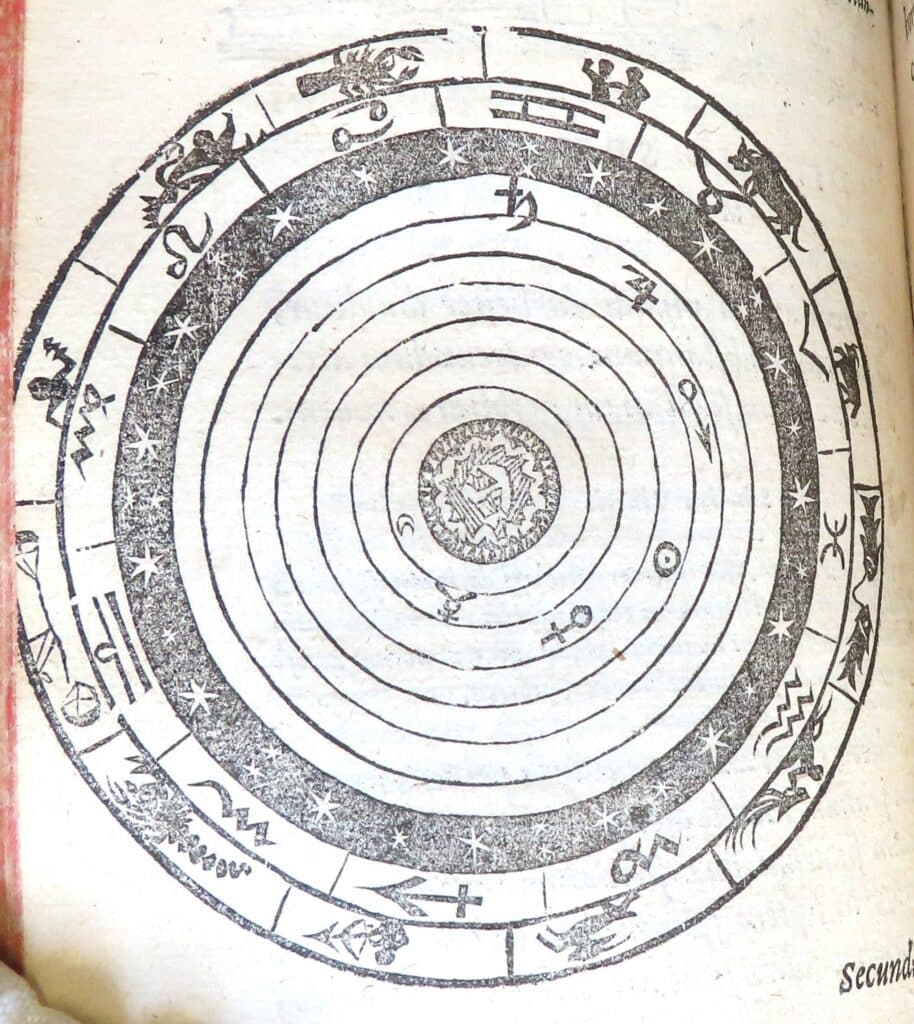
Various theories speculated that earth and water had different centres of gravity, that the shape of one or the other was not spherical, or that earth and water interlocked to form a single globe, as illustrated in 16th-century printed editions of the Tractatus de Sphera, composed by Joannes de Sacro Bosco between 1220 and c.1250. This was the standard textbook for students across western Europe, still used by Galileo in his lectures at Padua in 1610.
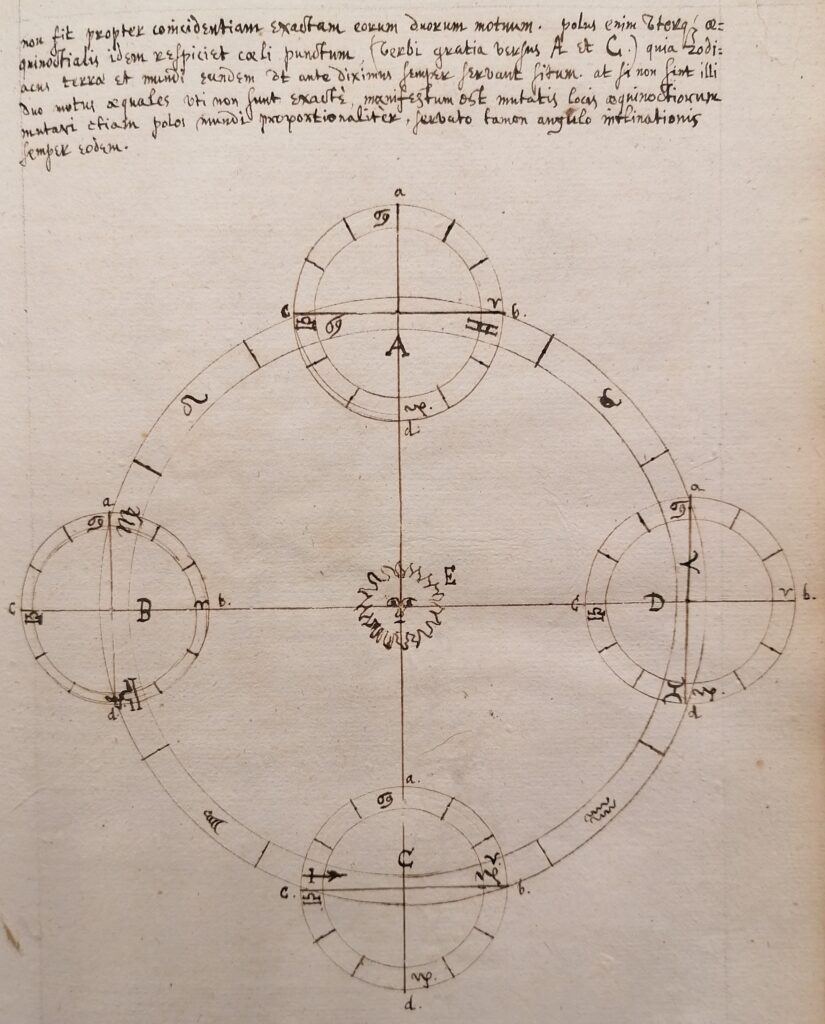
Copernicus’s ground-breaking treatise De revolutionibus orbium coelestium [‘On the Revolutions of the Celestial Spheres’) published in 1543 rejected long-held notions of overlapping spheres with two or even three displaced centres of gravity. In the third chapter of the book, he asserted that the geographical discoveries of Amerigo Vespucci in the New World at the turn of the 15th to 16th centuries proved that earth and water formed one ‘terraqeuous globe’ with a single geometrical centre of gravity.
Copernicus’ principal aim was to simplify astronomical calculations, and his adoption of the terraqueous globe model ultimately led him to theorise a heliocentric solar system, in which the Earth itself (with the Moon rotating around it) was a planet orbiting the Sun: the first time that long-standing philosophical theory was destroyed by a newly discovered empirical fact.
Further reading: David Wootton, The invention of science: a new history of the scientific revolution (2015)
Find out more about the history of the four elements in the Verey Gallery exhibition, Elemental
[https://collections.etoncollege.com/whats-on/exhibitions/elemental/]
Stephie Coane, Deputy Librarian, College Library